


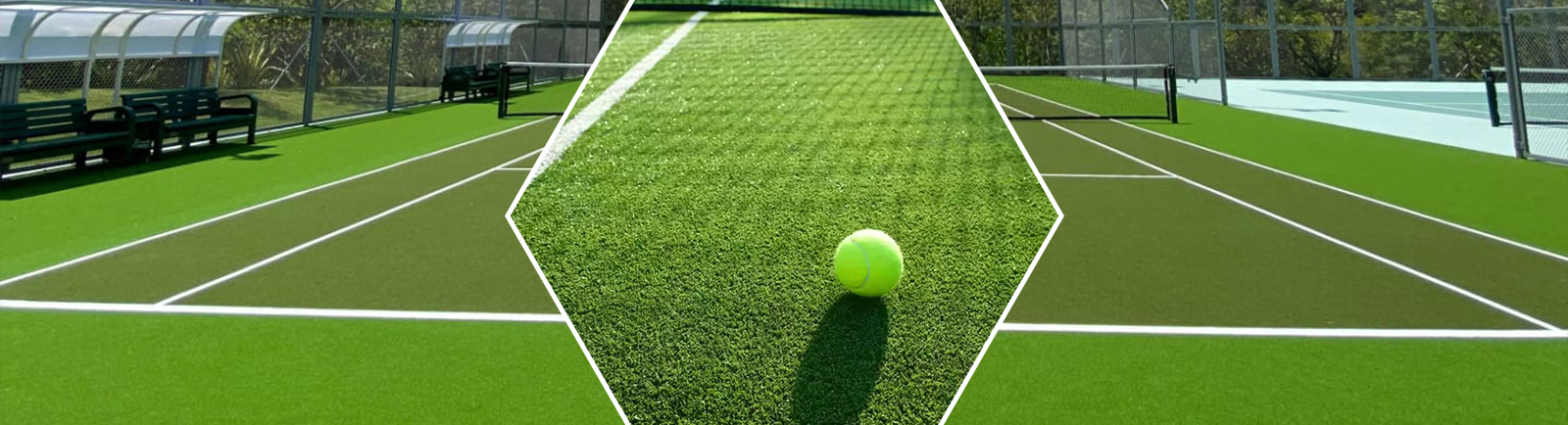
Yes, artificial tennis turf can be used for outdoor tennis courts. But before choosing it, there is one thing worth clearing up: not every type of artificial grass is suitable for playing tennis.
A tennis court gets a lot of movement. Players are constantly running, stopping, turning and pushing off the surface. The court also has to deal with rain, sunlight, dust and regular foot traffic. So the turf needs to be made for sports use, and the surface underneath it needs to be prepared properly.
For some outdoor courts, artificial tennis turf can be a practical alternative to a conventional hard surface or natural grass. Whether it is the right choice depends on how the court will be used and what kind of playing experience is expected.
Artificial tennis turf is a synthetic playing surface made for tennis and similar sports. It may look like ordinary artificial grass at first glance, but the construction is different.
Garden artificial grass is mainly installed because it looks like a well-kept lawn. Tennis court turf has a much harder job. It needs to withstand repeated movement and remain suitable for regular play.
The turf is usually laid over a prepared base. Some systems also use infill, which helps support the fibres and affects the way the surface behaves.
So when talking about a tennis court surface, it is better to think about the whole system rather than just the visible grass.
Yes. Artificial tennis turf can be installed on an outdoor tennis court, and one of its useful features is that it does not depend on natural grass to stay in good condition.
Rain is one of the main things that needs attention.
An outdoor tennis court should have a proper drainage arrangement so that rainwater can move away from the playing area. If water is allowed to sit on the surface, it can affect play and may eventually cause other problems.
This is where the preparation underneath the turf becomes important. Good-quality turf cannot make up for a badly prepared base.
The location of the court matters too. A court surrounded by trees may collect more leaves, while an exposed site may receive more dust and wind-blown debris. These things are easy to overlook when planning the court but become obvious once players start using it.
No, and this is something worth checking before buying anything.
Artificial grass for tennis courts is different from the synthetic grass used for gardens. The two products may look similar, but they are designed for different purposes.
Tennis players put much more stress on a surface than someone simply walking across a lawn. Repeated starts, stops and changes of direction can quickly expose weaknesses in a product that was never intended for sports use.
When choosing artificial tennis turf, check that it has been made for sports applications. Its fibre construction, density, pile characteristics and infill requirements can all affect how it performs.
In short, don't choose a product just because it looks like the right grass.
That depends on the particular court.
A hard tennis court has a firm feel that most players recognise. An artificial tennis court gives a different experience, and some players may find it more comfortable during longer recreational sessions.
There is no point pretending that every artificial turf court feels the same. The turf itself is only part of the equation. The base underneath it, any infill used, and the way everything has been installed can change the feel of the finished court.
If you're planning a court for regular use, try to find somewhere with a similar surface. Standing on a sample of turf is not quite the same as actually running across a tennis court.
This is probably more important than how the turf looks.
Tennis players need to know what the ball is going to do when it hits the court. A surface with uneven areas or problems underneath can produce an inconsistent bounce.
An artificial tennis court can provide suitable playing conditions, but the result depends on the construction of the court. The foundation needs to be level, the turf needs to be installed correctly, and any infill needs to be appropriate for the system.
That's why it is worth asking about the playing characteristics of the complete court rather than judging the turf by itself.
There are some straightforward reasons.
There is no lawn to cut every week. This is a simple benefit, but it can save a fair amount of time over the life of an outdoor court.
Natural grass needs water to remain healthy. Synthetic turf doesn't, which can be useful in areas where water use is a concern.
Artificial turf remains relatively consistent in appearance throughout the year. It won't turn brown simply because the season has changed.
Sports turf is made to cope with repeated use. That makes it an option for everything from private courts to schools and sports facilities, provided the product is chosen according to the level of traffic.
A properly built outdoor tennis court can allow water to pass through the turf and into the drainage layers below. This can be particularly useful for an outdoor tennis court in a rainy area.
Of course, the drainage has to be designed properly in the first place.
Yes. It is easier to maintain in some ways than natural grass, but it is not a surface that can simply be forgotten.
Outdoor courts collect dirt. Leaves fall onto them, dust blows across them, and players bring small amounts of debris onto the surface.
Regular cleaning helps keep the court usable.
Some tennis court turf systems also need brushing. This can help keep the fibres in good condition and maintain the distribution of infill where infill is part of the system.
It is also sensible to check the areas that get the most use. The baseline and other high-traffic sections may show wear before the rest of the court.
None of this is particularly complicated. The main point is to deal with small maintenance jobs before they turn into bigger repairs.
This deserves attention if the court is being built somewhere with a hot climate.
Artificial surfaces can become warm when they sit in direct sunlight for several hours. The amount of heat will depend on the weather, the surface itself and how much direct sun reaches the court.
The position of the court can therefore make a difference.
Before construction begins, look at the surrounding buildings, trees and other sources of shade. Think about which part of the day gets the strongest sunlight.
These details won't necessarily determine whether artificial tennis turf can be used, but they can affect how comfortable the court is for players.
Possibly.
An existing court may be suitable for conversion if the foundation is stable and the surface is reasonably level. However, cracks, drainage issues, and major uneven areas should be dealt with first.
Putting new turf over a damaged base is rarely a good long-term solution. The problem underneath hasn't disappeared just because it is no longer visible.
For example, if water already collects in one corner of an old court, installing turf over that area won't magically give the water somewhere to go.
An inspection of the existing court can help determine whether it is suitable for conversion or whether additional groundwork will be needed.
There isn't a fixed answer.
A private artificial tennis court that gets used a few hours a week will experience much less wear than a busy tennis club where players are on the surface throughout the day.
The quality of the turf matters, but so do installation, weather, and maintenance. A court that is kept clean and properly maintained is likely to remain in better condition than one that is neglected.
The best approach is to choose the turf according to the amount of use you expect rather than assuming every product will last the same amount of time.
The first thing I'd avoid is choosing turf based purely on its appearance.
Instead, ask some practical questions:
• Is the product designed for tennis or other sports?
• What kind of base does it need?
• How will rainwater leave the court?
• Does it require infill?
• What maintenance does the manufacturer recommend?
• Is it suitable for the local weather?
• How much use is it designed to handle?
• What happens if one section becomes damaged?
Also look at the installation plan.
A good piece of tennis court turf cannot compensate for a poor foundation. If the base is uneven or drainage has been overlooked, the finished court may not perform as expected.
It really depends on the people who will be using the court.
Hard courts are popular because they provide a firm surface and a familiar playing experience. An artificial tennis court offers something different.
Some players may prefer the feel of synthetic turf, while others will be more comfortable with a traditional hard surface. Maintenance requirements are different as well.
For a private court, personal preference may be the deciding factor. For a school or club, the amount of daily use and maintenance available may matter more.
There is no single surface that works best for every tennis court.
Yes, particularly if you want an outdoor court that avoids some of the upkeep associated with natural grass.
Artificial tennis turf can work well when the right sports-grade product is installed on a suitable base with proper drainage. It can provide a consistent-looking surface and handle regular recreational use when it is maintained correctly.
The important thing is not to treat the turf as the whole court. What happens underneath it matters just as much.
Before making a decision, think about the players, the climate, the amount of use, drainage, maintenance, and the type of playing experience you want.
Once those things are clear, it becomes much easier to decide whether an artificial tennis court is the right fit for the site.
...